


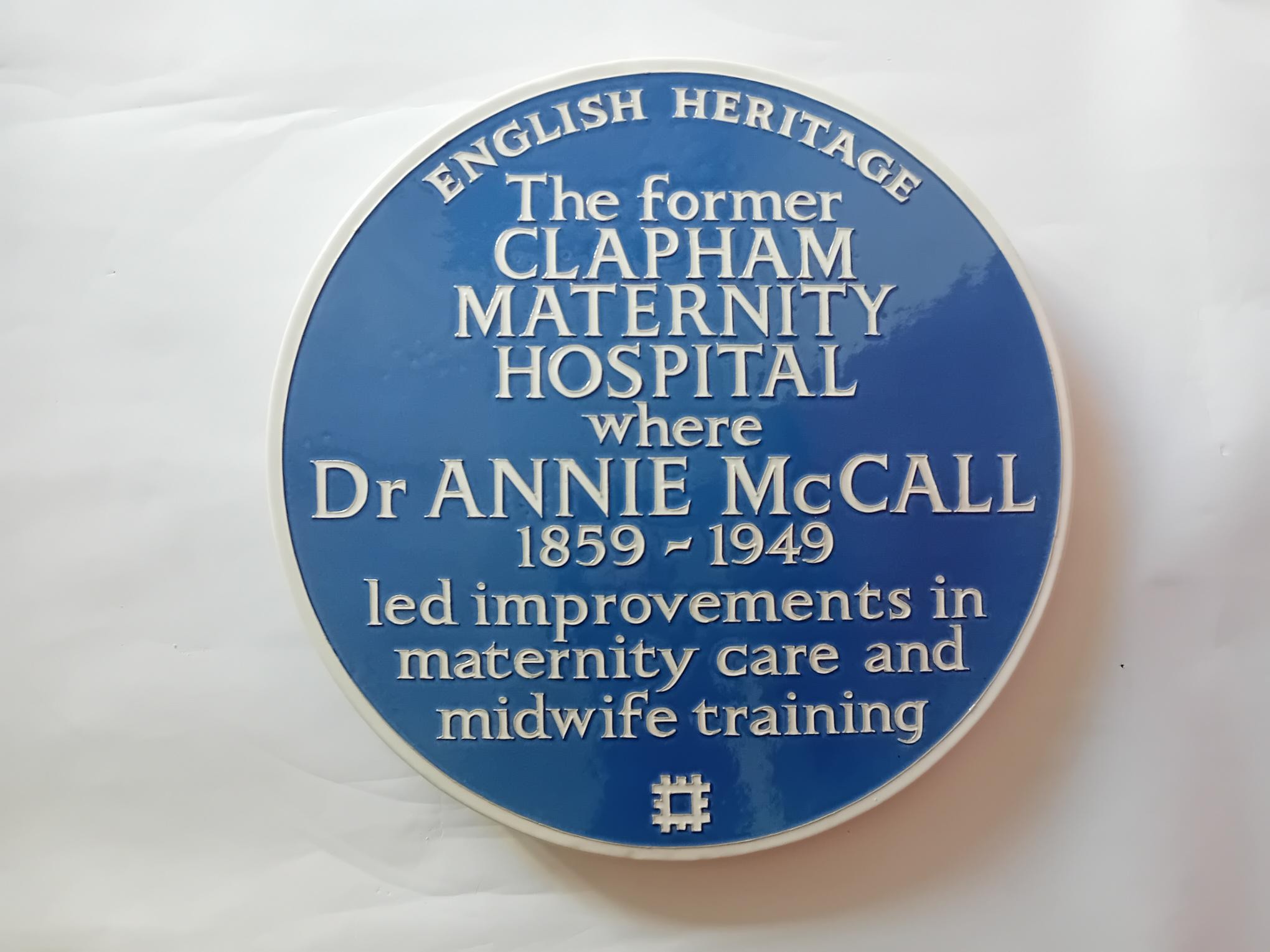
Dr Annie McCall, who transformed maternity care and midwifery training, has been commemorated by English Heritage.
Two pioneering women, dedicated to improving the lives of others, will be commemorated with blue plaques by English Heritage, the charity announced recently. In Stockwell, a plaque will mark part of the former maternity hospital established by Dr Annie McCall (1859–1949) on Jeffreys Road. In Westminster, a second plaque will honour social reformer Gertrude Tuckwell (1861–1951), who campaigned for better conditions for working women and helped shape some of the earliest legislation protecting them. Her plaque will mark Westminster Mansions on Little Smith Street, where she lived when she helped establish both the National Anti-Sweating League and the National Federation of Women Workers.
English Heritage Historian, Howard Spencer, said: “Separately, Annie McCall and Gertrude Tuckwell each saw where women were being failed by existing systems and set about changing them: McCall through improving maternity care and midwifery, and Tuckwell through her broad campaigning for better conditions for working women. Their plaques offer a chance to celebrate two women who, in very different fields, helped to reshape the opportunities and lives of women in London and across the country.”
Dr Annie McCall worked tirelessly to provide better maternity care at a time when most midwives in England were unqualified and maternal and stillbirth rates were high. After qualifying as a doctor in 1885, she established an antenatal clinic and, in 1889, founded the Clapham Maternity Hospital. Its School of Midwifery was the first in Britain to be run for women, by women. McCall was also a progressive champion of care for single women and placed an unusually strong emphasis on antenatal care. In the 1890s, maternal mortality at the hospital was less than half the rate for the country as a whole.
English Heritage historian Dr Susan Skedd said: “McCall was not simply providing maternity care; she was helping to establish midwifery as a properly trained profession and creating opportunities for women to enter medicine and healthcare at a time when those opportunities were still severely limited.
“It is particularly fitting that the plaque is going on a surviving part of McCall’s maternity hospital, because this was the place where her vision for better maternity care and the training of women in midwifery was put into practice.”
Gertrude Tuckwell devoted her life to improving the conditions of working women. A leading figure in the women’s trade union movement, she investigated the dangers faced by women workers. She helped establish the National Anti-Sweating League in 1906 and, with fellow blue plaque recipient Mary Macarthur, founded the National Federation of Women Workers, serving as its first president.
English Heritage historian Dr Rebecca Preston said: “Tuckwell understood that improving women’s lives meant tackling the conditions in which they worked. Her campaigning exposed dangerous and exploitative working conditions and helped turn the demand for better treatment of women workers into changes in the law. And her being London’s first woman magistrate is a notable achievement in itself.
“Close to the parliamentary corridors of power, Westminster Mansions is a particularly appropriate address for Tuckwell’s plaque. She was living there when her campaigning moved from investigation and agitation into tangible achievement, with the National Anti-Sweating League and National Federation of Women Workers coming into being and the minimum wages in certain trades being enacted into law.”
The English Heritage London Blue Plaques Scheme also commemorates the first woman to qualify as a doctor in Britain, Elizabeth Garrett Anderson; the trade unionist and campaigner for working women Mary Macarthur; and the Match Girls’ Strike of 1888. 2026 also marks 150 years since the first blue plaque to a woman was erected, commemorating actress Sarah Siddons at her former home in Upper Baker Street in 1876. Although the building was later demolished and the plaque is no longer in place, Siddons’ plaque marked an important milestone, and English Heritage continues to work towards greater gender balance in the London Blue Plaques Scheme.
Image and source supplied by English Heritage


SUBSCRIBE TO OBS GYNAE & MIDWIFERY NEWS
and receive all of the latest news via our weekly newsletter
"*" indicates required fields