


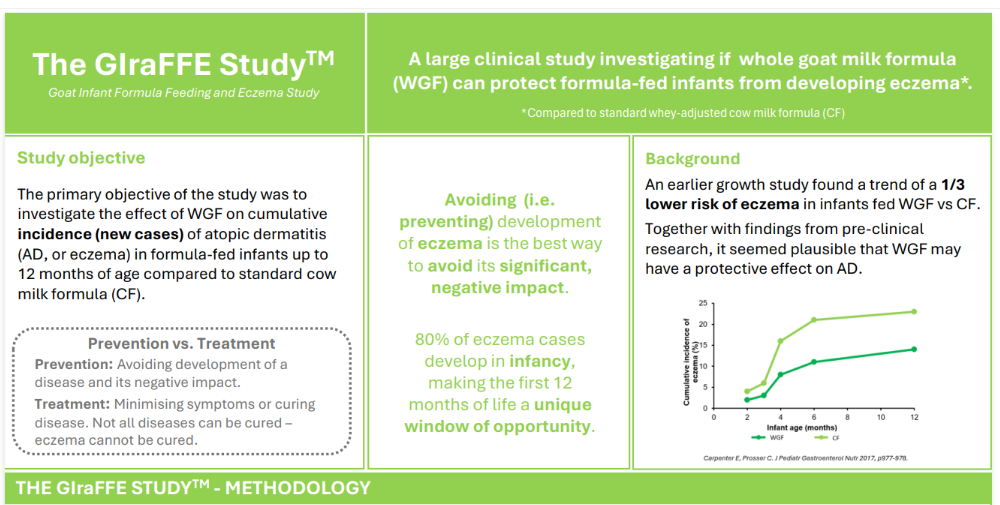
One of the largest multicentre double-blind randomised controlled trials to date has found that whole goat milk formula (WGF) can significantly reduce the incidence of atopic dermatitis (AD) diagnosed by a doctor in formula-fed infants in the first year of life by 34%.
The study, which involved more than 2,100 infants, has been published in Clinical Nutrition.¹
Led by a team of researchers from LMU Munich, the Goat Infant Formula Feeding and Eczema (GIraFFE) study also found that in infants with a parental history of AD, feeding WGF reduced the risk of doctor-diagnosed AD up to one year of age by 64%, compared to standard cow milk formula (CF). The rate of AD diagnosed only at three study visits and based on standardised criteria was unaffected by formula choice in all infants but was also lower in infants with a family history of AD feeding WGF.¹
“Breastfeeding is the best choice for infant feeding. However, this study is important for infants receiving formula milk because it shows that whole goat milk formula can help prevent eczema development in six out of ten formula-fed infants with a parental eczema history,” said Professor Berthold Koletzko, Dr. von Hauner Children’s Hospital, University of Munich. “This is critical because eczema is a chronic condition that can induce a severe burden for affected children and their families. It not only predisposes them to other inflammatory conditions such as food allergies, asthma, and allergic rhinoconjunctivitis, but it also impacts development, sleep, and quality of life of the child and the whole family.”²
AD is a common skin condition that affects 10–30% of children worldwide, with most cases appearing in the first year of life.³ It can cause dry, itchy, and inflamed skin and often marks the beginning of what has been referred to as the “atopic march”, a progression towards.
The results of the GIraFFE study offer a significant opportunity for allergy-related disease prevention for formula-fed infants. “This study provides key evidence on the effect of formula choice and the development of atopic dermatitis and is a step in reshaping the approach to formula feeding,” said Dr. Elisabeth Weichselbaum, Chief Scientific Officer at Dairy Goat Co-operative (DGC), which provided the formulas tested in the trial.
She added, “The GIraFFE study reflects Dairy Goat Co-operative’s commitment to better outcomes for formula-fed infants. We have a deep understanding and expertise in goat milk nutrition and crucially these results are specific to Dairy Goat Co-operative’s whole goat milk formula and our unique approach.”
DGC utilises a gentle processing method to process their WGF, which retains the natural protein profile and approximately 50% of the goat milk fat as the fat source. Due to an inherently lower level of alpha S1-casein protein in goat’s milk from the selected goat herd of the DGC farmer owners, the whole goat milk naturally forms a softer curd, so no whey protein needs to be added to make it easy to digest for infants.⁴ This means no additional beta-lactoglobulin, a key allergen in goat and cow milk whey protein that is not present in human milk, is added. The lower level of the beta-lactoglobulin allergen minimises the overall allergic potential of WGF compared to whey-adjusted formulas. In addition, about half of the fat in the WGF is goat’s milk fat, believed to have modulating effects on infants’ immune response.
The results of the GIraFFE study, which was co-funded by the New Zealand Ministry for Primary Industries (MPI), apply to DGC manufactured WGF. The GIraFFE study will continue to follow participating children until they reach five years of age to better understand the longer-term effects on allergy development and overall health.
The GIraFFE study rationale and design were based on findings from the earlier TIGGA study supported by DGC, a randomised controlled trial of two hundred formula-fed infants in Australia to assess growth and nutrition status in infants fed WGF and CF. A post hoc analysis of the TIGGA study showed a trend of a one third lower cumulative incidence of eczema over 12 months in healthy infants fed WGF.⁵ These clinical studies add to an existing body of evidence supporting the benefits of WGF for infancy and childhood.
Source: GCI Health
References:
¹ Grote V, Schlosser L, Campoy C, et al. (2026). Whole Goat Milk versus Cow Milk Formula and Atopic Dermatitis in Infants: A Randomized Clinical Trial. Clinical Nutrition, 106707. In press.
² Bieber T. (2008). Mechanisms of disease: Atopic dermatitis. Review Article. N Engl J Med, 358(14), 1483–1494.
³ Kolb L, Ferrer-Bruker SJ. Atopic Dermatitis. [Updated 2023 Aug 8]. In: StatPearls [Internet]. Treasure Island (FL): StatPearls Publishing; 2026 Jan-. Available from: https://www.ncbi.nlm.nih.gov/books/NBK448071/
⁴ Gallier S, Tolenaars L, Prosser C. (2020). Whole Goat Milk as a Source of Fat and Milk Fat Globule Membrane in Infant Formula. Nutrients, 12(11), 3486.
⁵ Zhou, S. J., Sullivan, T., Gibson, R. A., Lönnerdal, B., Prosser, C. G., Lowry, D. J., & Makrides, M. (2014). Nutritional adequacy of goat milk infant formulas for term infants: a double-blind randomised controlled trial. The British Journal of Nutrition, 111(9), 1641–1651. https://doi.org/10.1017/S0007114513004212
Image: Submitted with press release by GCI Health


SUBSCRIBE TO OBS GYNAE & MIDWIFERY NEWS
and receive all of the latest news via our weekly newsletter
"*" indicates required fields