


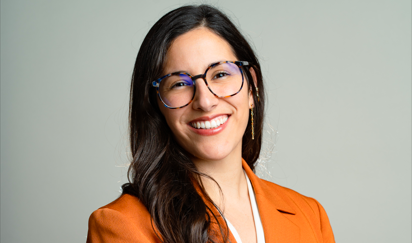
Maria Teresa is a biophysicist and founder of endogene.bio, a company using menstrual blood to generate high-resolution molecular data that enables non-invasive diagnostics and data-driven drug discovery in uterine health. She has extensive experience in biotech and pharma, having worked as a Fertility Portfolio Expansion Manager and In-House Consultant at Merck KGaA. Maria Teresa holds a PhD in Medical Devices and a Master’s in Bioscience Enterprise from the University of Cambridge, where she has lectured on female health and innovation in women’s medicine.
OGMN: What drove you to choose a career in scientific research, particularly in helping to address the historical underrepresentation of female biology in medical research and bring precision medicine to female health?
I’ve always been interested in applying quantitative science to real clinical problems, particularly in areas where biology is complex but still underserved. While working in pharma, I saw how precision medicine transformed oncology once diseases were defined at the molecular level. In contrast, many conditions affecting women are still approached with limited biological stratification.
Endometriosis is a clear example: it is highly prevalent, yet diagnosis remains slow and treatment decisions often rely on symptoms rather than measurable biology. That gap is both a scientific and a healthcare challenge.
Having endometriosis myself gives me a direct understanding of how urgently better diagnostics and stratification tools are needed. This is why I created endogene.bio: to use menstrual blood as a non-invasive window into uterine health and to help bring more innovative medicine into the field.
OGMN: Recently, endogene.bio published research showing that endometriosis is far more biologically diverse than current clinical practice assumes, a shift similar to the moment when breast cancer stopped being treated as a single disease and began to be understood through its molecular subtypes. Could you tell us more about your research and findings?
Our recent preprint focuses on a core challenge in endometriosis research: patients can present with the same diagnosis, yet respond very differently to the same therapy. Our hypothesis was that this variability reflects underlying molecular heterogeneity at the cellular level.
Using single-cell transcriptomic data, we examined gene activity in specific cell types rather than treating lesion tissue as uniform. We identified recurring disease-associated molecular programs concentrated in stromal, endothelial, and stem-like cell populations.
By linking these signatures to a computational drug-response framework, we identified distinct responder subgroups and predicted that different therapeutic mechanisms may be more relevant for different patients. The findings support the conclusion that endometriosis is not biologically uniform, but composed of molecularly distinct states that may influence therapeutic response.
This has direct implications for clinical trials, where biological heterogeneity may contribute to inconsistent outcomes if not accounted for in study design.
OGMN: What could this more personalised care do for the patient experience when treating endometriosis in women?
If endometriosis can be stratified into biologically distinct subgroups, treatment decisions can move beyond trial-and-error approaches.
Instead of relying primarily on symptom severity or surgical staging, clinicians could align therapies with the molecular programs active in each patient’s disease. This could reduce exposure to ineffective treatments, minimise side effects, and improve confidence in clinical decision-making.
It may also help patients and clinicians better understand why a therapy works well for one person but not for another. Over time, stratification approaches could also support more objective monitoring of treatment response using biomarkers, rather than relying on trial and error.
OGMN: You also believe in the potential for menstrual blood based sampling to support non-invasive patient stratification. How does this look for future treatments? ‑ blood‑based sampling to support non‑invasive patient stratification. How does this look for future treatments?
A major limitation in endometriosis research is access to lesion tissue, which typically requires surgery and makes repeated sampling difficult. This limits our ability to study treatment response and track disease biology over time.
Our findings suggest that menstrual blood can capture molecular signals that reflect disease-associated cellular states. In our methylation study, we showed that menstrual blood–derived stem cells carry disease-specific epigenetic patterns. In our single-cell analysis, we observed that drug response–associated transcriptional signatures present in lesion stromal cells are also detectable in eutopic endometrial stromal cells shed during menstruation.
This raises the possibility that menstrual blood sampling could help stratify patients for specific therapies and potentially monitor how their disease biology changes in response to treatment. In the long term, this could support more targeted treatment selection and better-designed clinical trials.
OGMN: Are you currently involved in any other research projects? If so could you tell us more about their focus?
Beyond the work I’ve described, we are currently focused on expanding our methylation-based diagnostic validation and building partnerships to support clinical translation. We’re also exploring how menstrual blood-derived molecular data can inform drug discovery by identifying new therapeutic targets specific to disease subtypes.
Our priority is ensuring that the research translates into tools that can actually be used in clinical practice and drug development.
OGMN: How does the future look in improving endometriosis care?
I’m optimistic about where the field is headed. I think the future of endometriosis care will be defined by two major shifts: earlier diagnosis and biology-driven stratification.
Diagnosis is still often delayed and dependent on imaging or surgery. Our methylation study supports the potential for molecular diagnostics using menstrual blood, which could help shorten diagnostic timelines and enable earlier intervention.
At the same time, our single-cell work shows that endometriosis is not a single biological entity. Identifying molecular subtypes and responder groups could improve clinical trial design, enable more targeted treatment decisions, and help explain why some therapies work well for certain patients but not others.
Importantly, understanding the specific cellular programs driving disease may also support the development of new treatments by revealing distinct therapeutic vulnerabilities within defined patient subgroups.
Integrating molecular tools into both research and care will be essential; not only to detect disease, but to guide how we design, test, and select therapies in the future.
OGMN: What’s the best part of your job?
The best part of my job is, without question, my team. They are extraordinary – not only in their scientific and technical excellence, but in their humanity. Biotech can be intense: difficult investor meetings, long days, real pressure. What I value most is coming back from a tough day and walking into a room full of people who care deeply about the science, the mission, and each other. They remind me why we are doing this in the first place. They bring me back to where my heart should be and what is truly worth fighting for.
I also love our technology. Every day, I learn more about my own disease, and that is truly empowering. Understanding something gives you power over it. It makes it less frightening. When you understand why symptoms happen and the biology behind them, you feel more in control. That shift, from fear to knowledge, is transformative. Being able to build that understanding, not just for myself but for others, is a privilege.
OGMN: … and the worst?
The hardest part of my job is the personal cost. Building a company leaves very little free time, and the responsibility never really switches off.
It can also be challenging to operate in an environment where financial metrics sometimes dominate the conversation. Of course, businesses need to be sustainable, that’s a reality. But when you’re working on a disease that affects patients’ daily lives, it can be difficult to hear suffering reduced to market size, revenue projections, or “go-to-market” strategy. There’s a human story behind every data point.
Women’s health still faces barriers that feel outdated and, at times, unfounded. That can be frustrating. But it also reinforces why this work matters. If the system doesn’t naturally prioritize these patients, then we have to push harder to make sure it does.
OGMN: What has been the highlight of your career so far?
While there have been many milestones I cherish – receiving our first sample in the lab, seeing our first study results, enrolling our first patient – my defining moment actually dates back to my time at Merck, when I was living in Japan for an assignment.
There, I worked with the Head of Clinical Operations, David Hernandez, who fundamentally changed how I saw clinical development and the relationship pharma can, and should have, with patients. Under his leadership, we organized one of the first patient advisory boards in Japan to formally integrate patient input into clinical trial design, which was far from common practice at the time.
A small detail has stuck with me since. When we asked patients what they would change about their experience in clinical trials, many said they wished they had simply been informed when the trial ended, even if their own participation had already concluded. They said they would have appreciated a thank-you note.
These were individuals contributing their time, their bodies, and their future to science, and what they wanted most was acknowledgment. That moment reshaped how I think about medicine. Clinical development is not just about protocols and endpoints, it is about relationships and responsibility. If we are developing treatments for patients, they deserve more than to be data points. They deserve partnership and respect from the very beginning.
OGMN: Are you planning to attend or speak at any medical conferences or events in 2026?
Yes. I will be speaking at LSX Lisbon in March 2026 on a panel titled “Silicon Meets Science: AI’s Make-or-Break Moment in Biotech.” The panel will examine whether AI has delivered meaningful progress beyond target discovery, whether AI-designed drugs are likely to dominate the 2030 pipeline, and the key question of whether AI can realistically reduce clinical failure rates.
I will also be speaking at Health.Tech in Basel in March, where I will be leading a workshop on endometriosis.
In the first half of 2026, my colleagues and I will also attend EEC, the SEUD Congress and pre-congress, and ESHRE, specialised endometriosis and fertility conferences, to present some of our latest results. It’s going to be a busy year, but these are important opportunities to engage with the clinical and research communities.
OGMN: If you didn’t work in the health industry, what would you be?
If I weren’t leading a biotech company, I would be a science teacher. Teaching runs in my family, and it’s a profession I deeply admire. I’ve seen firsthand the ripple effect a single teacher can create. One of my cousins once introduced a simple recycling activity in her classroom in Fuerteventura. What began as a small initiative grew into something much larger – the children embraced it, asked for it themselves, explained it to their families, and even tried to implement it at home. That’s real, lasting change.
In entrepreneurship, we often say we are building the future. But without great teachers, there is no foundation. There would be no one to teach us the maths behind a business model or the biology behind a biotech breakthrough. More importantly, teachers shape values. They instil curiosity, critical thinking, responsibility, and ethics at a formative stage of life. In today’s political climate, that role feels more important than ever. In many ways, teaching is one of the few professions that can truly help safeguard the future.
OGMN: What advice would you tell your 21-year-old self?
I would tell my 21-year-old self that she was about to have a wonderful life. The moments that feel like detours won’t be mistakes, they will be preparation.
You are getting ready for something big, even if you can’t see it yet. So be patient. Learn fast. Absorb everything. Every country, every role, every challenge is building a muscle you’ll need later.
OGMN: How do you think the future looks within the field of gynaecology and women’s health and what are your predictions for 2026 and the next decade?
I think women’s health is at a turning point. In many ways, precision medicine in gynaecology is probably 10 to 15 years behind where oncology was when molecular subtyping began to transform cancer care, but the field is now moving quickly in that direction.
Historically, many gynaecological conditions have been defined mainly through symptoms and anatomical findings, which don’t fully reflect the underlying biology. That has consequences not only for patient care, but also for drug development. If diseases like endometriosis are biologically heterogeneous, then clinical trials that treat all patients as a single group are more likely to produce mixed results and higher failure rates.
By 2026, I expect we will see more serious clinical validation efforts around non-invasive biomarkers and growing interest in stratifying patients based on molecular signatures. Over the next decade, I believe precision medicine will reshape how diseases like endometriosis are diagnosed and studied – with biologically defined subtypes informing clinical trial design and treatment decisions.
Ultimately, that shift should lead to earlier diagnosis, clearer treatment pathways, and therapies that are better matched to the biology driving disease in each patient.
Image and views submitted by the author


SUBSCRIBE TO OBS GYNAE & MIDWIFERY NEWS
and receive all of the latest news via our weekly newsletter
"*" indicates required fields